Optical Topography
High-quality, real-time cerebral-cortex-imaging and measurement
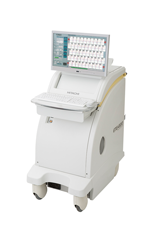
Every healthcare professional would say: "I wish I could see how the human brain is working in vivo." Hitachi’s highly portable, bedside optical topography system has made this dream come true and enables professionals to inspect and measure live, in-
The state-
- Compact, mobile and user-friendly
A highly portable, compact and light unit which is easy to wheel up to the bedside or around a clinic. It has an extremely user friendly and efficient on-screen interface and rapidly generates accurate test results. - Simultaneous multi-channel measurement
A wide range of probes and holders enable a variety of assessments. This system can be configured to simultaneously take 24, 48 or 52 channel measurements. - Live, non-invasive measurement with little or no patient restraint.
Just place the sensor on the scalp while the optical topographer captures and measures real time images of live brain activity.
- Measurement channels:
Available in 24 and 48 channel configurations. 52 channels can be measured with an optional 3x11 probe. - Measurements:
Changes in oxy-hemoglobin, deoxy-hemoglobin and total hemoglobin concentrations. - Light source:
Laser diodes of two wavelengths (695nm and 830 nm) measure oxy- and deoxy-hemoglobin simultaneously. The shorter wavelength light source enables multi-faced measurements with very low levels of background noise. - Display format:
Time-course graph display, 2D topographic images and mapped displays. - Data sampling rate:
10 samples per second. - Interface:
RS232 and BNC for external trigger and signal input/output. - Network:
LAN compatible for data sharing. - Data format:
Measurement data can be generated in text or Excel compatible files. Topographic images are available in BMP or AVI formats.
The ETG-4000 was engineered for ease of use in clinical and research environments. Possible fields of application include neuroscience, psychology, psychiatry, neonatology and education.
- Motor tasks.
- Speech recognition studies.
- Visual stimulation.
- Psychiatric disorders including depression and schizophrenia.
- Effects of aging (dementia) – development of preventive diagnostics.
- Neonatal – early detection of difficulties including audio sense, speech and visual.
- Pediatric – learning difficulties including ADHD and mental retardation.
- Language lateralization – assessment of hemispheric dominance for language before surgery (alternative to Wada test).
- Seizures – detection before surgery (epilepsy).
- Stroke assessment and rehabilitation
The research in functional near-infrared spectroscopy (fNIRS) is growing worldwide. Here are some recently published papers by European users of Hitachi Optical Topography systems.
The neonate brain detects speech structure
Keywords: language acquisition, newborns, optical imaging, perceptual primitives, speech perception
Gervain, Macagno, Cogol, Peno, Mehler
International School for Advanced Studies, Trieste, Italy
PNAS, Sep 16, 2008, Vol. 105, No 37
Activation of the Prefrontal Cortex in Working Memory and Interference Resolution Processes Assessed with NIRS
Keywords: prefrontal cortex, event-related, working memory, attention, interference resolution
Schreppel, Egetemeir, Schecklmann, Plichta, Pauli, Ellgring, Fallgatter, Herrmann
University of Wuerzburg
Neuropsychobiology 2008; 57:188-193
Diminished prefrontal oxygenation with normal and above-average verbal fluency performance in adult ADHD
Keywords: brain oxygenation, hyperfocus, verbal fluencey, ADHD
Schecklmann, Ehlis, Plichta, Romanos, Heine, Boreatti-Hümmer, Jacob, Fallgatter
University of Wuerzburg
Journal of Psychiatric Research 43 (2009) 98-106
Differential activation of frontal and parietal regions during visual word recognition: an OT study
Keywords: lexical decision, word frequency, lexicality, probabilistic mapping
Hofmann, Herrmann, Dan, Obrig, Conrad, Kuchinke, Jacobs, Fallgatter
Charité Berlin; University of Wuerzburg
Neuroimage 40 (2008) 1340-1349
Spatio-temporal differences in brain oxygenation between movement execution and imagery: A multi-channel NIRS study
Keywords: motor execution, motor imagery
Wriessnegger, Kurzmann, Neuper
University Graz
International Journal of Psychophysiology 67 (2008) 54-63
Functional optical signal analysis: a software tool for NIRS data processing incorporating statistical parametric mapping
Keywords: biomedical optics, data processing
Koh, Glaser, Flandin, Kiebel, Butterworth, Maki, Delpy, Elwell
University College London
Journal of Biomedical Optics 12(6), 064010 (November/December 2007)
Event-Related Functional Near-Infrared Spectroscopy (fNIRS) Based on Craniocerebral Correlations: Reproducibility of Activation?
Keywords: retest reliability, reproducibility, event related, motor task
Plichta, Herrmann, Baehne, Ehlis, Richter, Pauli, Fallgatter
University of Wuerzburg
Human Brain Mapping 28:733-741 (2007)
Model-based analysis of rapid event-related functional near-infrared spectroscopy data: a parametric validation study
Keywords: time-series-analysis, GLM, Two-stage ordinary lease square, OLS, parametric design
Plichta, Heinzel, Ehlis, Pauli, Fallgatter
University of Wuerzburg
NeuroImage 35 (2007) 625-634
Cerebral oxygenation changes in the prefrontal cortex: Effects of age and gender
Keywords: sex, aging, verbal fluency task
Herrmann, Walter, Ehlis, Fallgatter
University of Wuerzburg
Neurobiology of Aging 27 (2006) 888-894
Multi-channel near-infrared spectroscopy detects specific inferior-frontal activation during incongruent Stroop trials
Keywords: Stroop task, cognitive interference
Ehlis, Herrmann, Wagener, Fallgatter
University of Wuerzburg
Biological Psychology 69 (2005) 315-331
Towards a standard analysis for functional near infrared imaging
Keywords: general liner model, spectral analysis, visual stimulation
Schroeter, Bücheler, Müller, Uludag, Obrig, Lohmann, Tittgemeyer, Villringer, v.Cramon
Max-Planck Institute, Leipzig
Neuroimage 21 (2004) 283-290
Sounds and Silence: An optical topography study of language recognition at birth
Keywords: left hemisphere dominance, neonates, forward speech, backward speech
Pena, Maki, Kovacic, Dehaene-Lambertz, Koizumi, Bouquet, Mehler
International School for Advanced Studies, Trieste
PNAS 2003, vol.100, no.20 11702-11705


